Original article: Psychiatry Live, posted November 12, 2026: authored by David Ellison, MS, Susan Hatters Friedman, MD, MSt, DFAPA, Renee Sorrentino, MD, Nora Douglas, MD
Key Takeaways
- Agency impersonation, romance, prize/award, phishing, and sextortion schemes commonly exploit fear, status, and attachment needs, with AI-generated content increasing credibility and victim compliance.
- Older adults often sustain disproportionate financial losses, while mild cognitive decline, high internet use, and low literacy correlate with greater susceptibility than severe impairment.
- Loneliness predisposes patients to romance scams, whereas financial insecurity and sanction-related anxiety heighten vulnerability to phishing and coercive payment demands.
- Routine psychiatric assessment can include direct questions about recent money requests, threats, “honors,” or humiliation/extortion, supplemented by tools like the Lichtenberg Financial Decision Screening Scale.
- Effective responses integrate staff training, patient education resources, psychotherapy for emotional fallout, and linkage to credit-card fraud services, law enforcement, and legal aid for identity-theft remediation.
“Mr Anthony,” an older adult, was admitted to the inpatient psychiatry unit following a suicide attempt precipitated by a financial scam. A person posing as a water company representative had called to say Mr Anthony was facing severe consequences without immediate payment for an outstanding balance. The $40,000 he sent to the scammer constituted a significant portion of his savings. Mr Anthony’s son discovered the scam and initiated proceedings for financial guardianship, an action Mr Anthony opposed. The scam exacerbated family tensions, leaving Mr Anthony feeling scared, trapped, and alone.
Financial exploitation is one of the most common and damaging impacts of scams. Individuals with limited resources and mental health vulnerabilities may be victimized in this way. The emotional burden of scams can cut deeper than their financial impact, according to a survey of victims from 30 European nations.1 Even if a person does not lose money following scam victimization, emotional effects often persist. Symptoms of anxiety and depression are correlated with financial exploitation.2,3 Scam victimization may be underreported due to embarrassment.4 With greater knowledge, mental health professionals can raise awareness and educate patients to help reduce their vulnerability.2,5
This article discusses the types of scams encountered in psychiatric practice, helps identify those at risk, and explores how mental health professionals across levels of care can prevent, assess, and intervene.
Types of Scams
Scams affect individuals from all walks of life. An exhaustive classification is beyond the scope of this article, in part because scams are constantly evolving. The Table describes scam types.
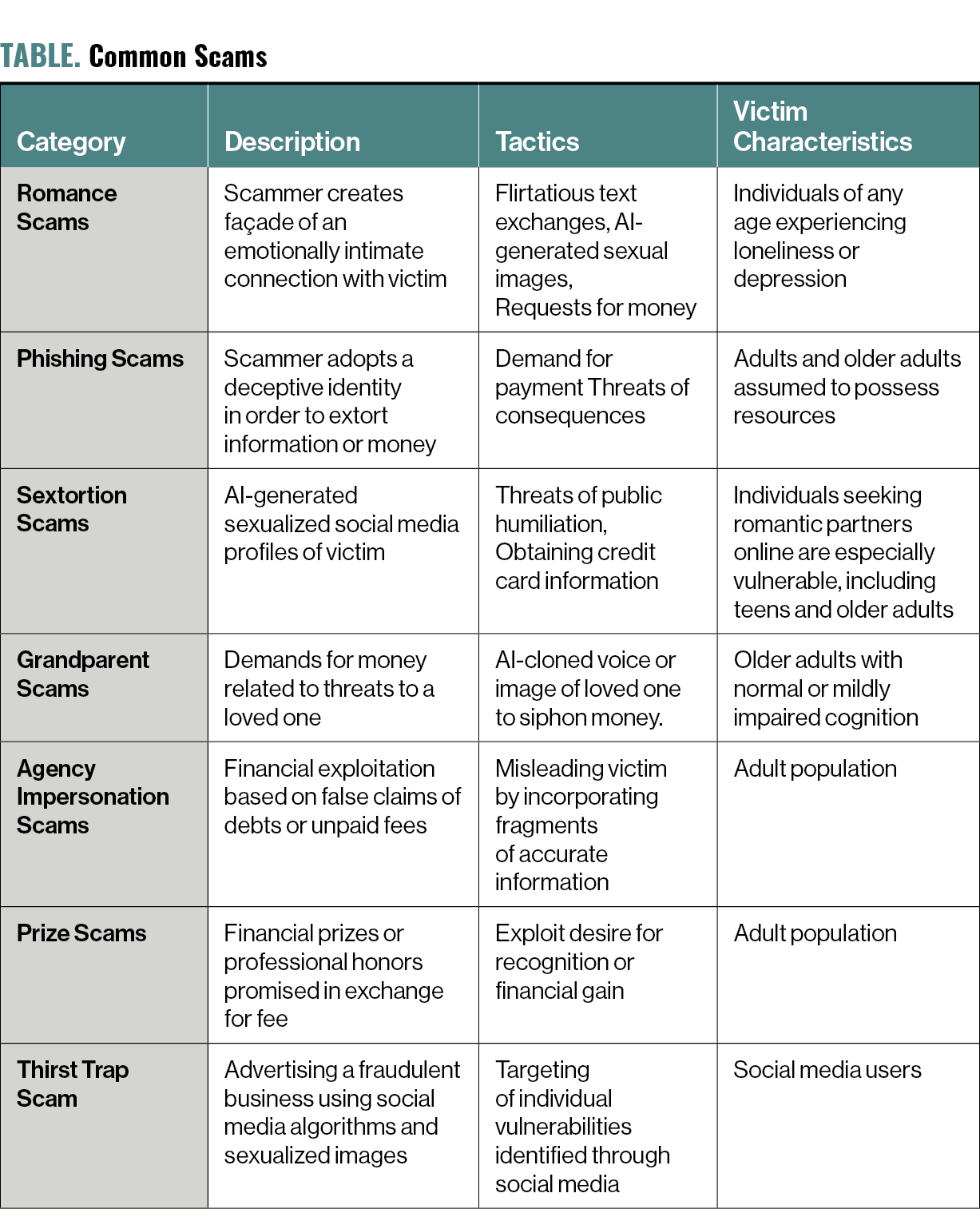
Table. Common Scams
Mr Anthony, who was threatened with a $40,000 water bill, was victimized by an agency impersonation scam, characterized by impersonating an authority or business and demanding payment for a fraudulent invoice (eg, fake toll payment text messages).
Another patient, “Mr Brody,” was victimized by a romance scam, which often targets psychiatrically vulnerable people.6 Mr Brody was a middle-aged man who was hospitalized due to suicidal thoughts, in the context of worsening depressive symptoms and substance abuse. He was cognitively intact yet socially awkward and lonely. During his admission, he asked the nursing staff to help him send money via his smartphone to someone with whom he appeared to be in a relationship. When he gave his phone to a staff member, she noticed a series of flirtatious text exchanges as well as AI-generated sexual images. Mr Brody insisted that these images were photos of a girlfriend, though he acknowledged they had never spoken directly or met in person.
Scammers succeed in part because victims are widely vulnerable. Studies indicate that educational attainment or an advanced degree does not prevent victimization.7,8 Even physicians succumb to scams, such as threats associated with government agency impersonation. Drug Enforcement Administration impersonators, for example, have threatened legal charges over unpaid, expired registrations. Physicians are also vulnerable to prize scams, such as being told they were nominated for a teaching award, designated as a keynote speaker, or solicited by predatory journals posing as legitimate academic publications. The promised “honor” is only accessible after paying a fee.
Vulnerabilities: Who Is at Increased Risk?
According to 2024 Federal Trade Commission data, while middle-aged adults are more likely to be victimized, older adults suffer greater financial loss.5 Mild cognitive decline, as opposed to severe cognitive impairment, has been correlated with greater scam vulnerability.8 More severely cognitively impaired older adults are protected from technology based scams as a result of their inability to utilize devices, though phone or in-person scams remain a danger. Individuals with lower literacy and higher internet use are at greater risk of victimization.7 Adolescents are at increased risk for romance scams or for “sextortion,” in which scammers obtain or create sexualized images of the victim to use for blackmail.9 Because adolescents have lower net worth than middle-aged or older adults, they may be less vulnerable to other types of scams.
Various scams exploit specific psychological liabilities. Individuals who struggle with loneliness may be more vulnerable to romance scams, for instance. Individuals with anxiety about financial security and fears about sanctions may be more vulnerable to phishing scams. Thirst trap scams target victims on social media, using attention-grabbing, sexualized images to advertise alleged services or products as a way to manipulate the viewer to send money or harvest personal data.